
Blog
Mind, Matter, Motion: what newborns teach me about the intelligence of the body
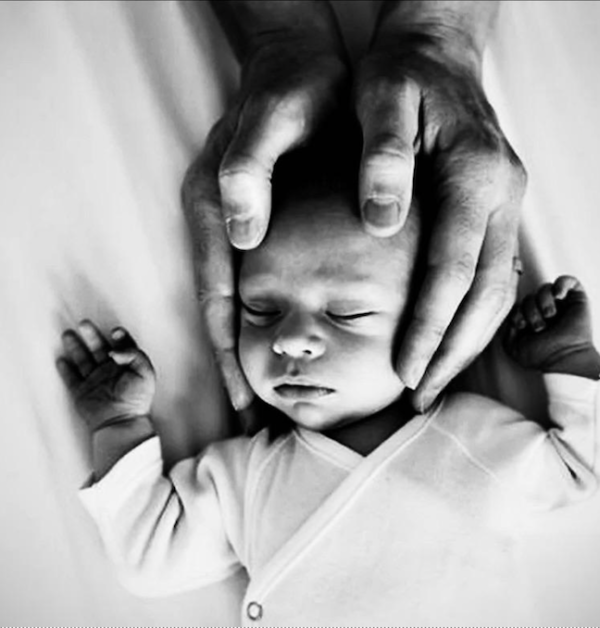
There is something that moves me every single time: a two-week-old newborn can show me more about how the body works than seven textbooks ever could.
When palpating* a baby’s little skull you often feel, quite literally, a clear hardening in the membranes and the still unossified bone structures. That hardening is not damage and not chance. It is resistance — an intelligent protective response to the enormous forces that pass through the tiny body during birth. The body holds firm in order to protect the brain and the vital functions.
Nowhere do I see the osteopathic principle as clearly as here: the body can heal itself when the structure is in balance. No habits, no compensations, no patterns built up over years. Only a little body that is still completely open — and that shows exactly what it has been through.
*Palpation is the diagnostic sensing of anatomical structures.
A truly holistic approach
In recent years this vision has been receiving more and more support from different angles. Psychology looks at how early experiences shape the nervous system and basic safety. Body-oriented and trauma-informed approaches speak of tension that settles when it has not been able to let go.
Osteopathy does something those other perspectives do not: it makes the concrete, tangible link back to the matter itself. No metaphor, no theoretical construct — a hardened cranial membrane that you feel under your hands. Where others speak of “stored tension,” osteopathy brings that tension back to the physical tissue in which it actually resides. That is what makes the approach truly holistic: mind, nervous system and matter in one and the same treatment.
Andrew Taylor Still built his entire philosophy on this insight more than a hundred years ago — long before “self-regulation” and “the body keeps the score” became common terms.
Mind, Matter, Motion
For Still, life arises from the unity of three principles:
- Mind — the organising intelligence of the body (nervous system and homeostasis),
- Matter — the physical structure,
- Motion — the movement that makes life visible, from joints to the flow of blood and lymph.
“Osteopathy is the law of mind, matter and motion,” he wrote in 1908. Not a technique, but the laws by which mind, body and movement form one whole.
Birth is perhaps the most radical moment at which this triad must reorganise itself: from intrauterine dependence to independent breathing, circulation and neurological regulation, in a matter of minutes. No wonder the body carries traces of it.
The three principles are inseparably connected and continually influence one another. Tension in the matter (cranial membranes) restricts the motion. Restricted motion affects the mind: the way a child processes stimuli and settles. Conversely, ongoing alertness keeps the tension in place. Structure, movement and regulation feed one another — in both directions.
The body never makes a mistake
Still wrote:
“Any change that the body makes on its own can only be towards health.”
The body never chooses illness. Every adaptation — including those hardened cranial membranes — is an attempt to survive and find equilibrium. What was an intelligent protective response during birth only becomes a complaint when it can no longer let go. A great deal of crying, difficulty relaxing, restless sleep: rarely mistakes of the body. It is a protective response that has remained.
What this means in practice
Osteopathy does not make diagnoses and does not replace the paediatrician. But it offers a gaze that few apply to a baby: not only looking at what seems wrong, but at what the body has intelligently been trying to do all along.
Through gentle, non-invasive techniques we help that held tension release, so that Mind, Matter and Motion can once again work freely together.
During birth the little head undergoes a natural process of moulding: the mobile cranial bones adapt temporarily to make passage through the birth canal possible. This is an essential physiological mechanism. With heavy mechanical load — such as a very rapid, prolonged or difficult delivery, when the head has been under pressure in the birth canal for a longer time, or in an instrumentally assisted birth with, for example, vacuum extraction — the body can build protective tension. When this tension is not fully released, it can remain in the intracranial membranes, the membranes that surround and support the brain.
What I see time and again: after a treatment, babies and children often make a leap in their development. As if space becomes available that should have been there all along.
More and more, midwives and infant welfare centres refer newborns preventively — not because something is necessarily wrong, but because early guidance can help the body find its way back more quickly to where it already wants to go: towards health.
Would you like to know more about the origins and principles of osteopathy?
Would you like to know more about the origins and principles of osteopathy? Then also read my earlier blog “The origins of Osteopathy: vision, belief, science and the self-healing capacity.”
 Wendy is an osteopath and former lecturer in osteopathy. She holds a Master`s degree in Physical Education and Movement Sciences and is the owner of Osteopathie Herengracht, Amsterdam.
If you are interested in our next blog, you can subscribe to our newsletter. You will then be the first to know about new blogs.